
Shipping: The Hidden Cost of Online Shopping

By on July 22, 2009 in Ideas


Online shopping is a convenient way for customers to seek out the best prices. But it is not as simple as one may think.

The consumer decision-making process consists of five stages:

  1. Need Recognition
  2. Information Search
  3. Evaluation of Alternatives
  4. Purchase Decision
  5. Purchase Evaluation

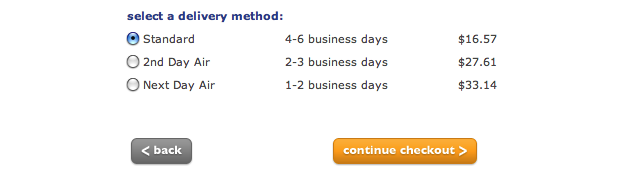
But what about the hidden costs of online shopping? How many of your customers make a purchase decision, accept the shopping cart total, only to close the web browser the moment they see the cost of shipping?

I know I do this on a regular basis, especially if the shipping cost is what I would consider inflated or unreasonable. Shipping isn’t something I enjoy paying for, because it doesn’t add anything of value to my order. I start the decision making process all over again, by reevaluating my “need” and searching for alternatives. I visit retailmenot.com seeking out free shipping coupon codes, google the product name + free shipping, or merely seek out a online store with a $5 flat shipping rate.

Many people feel that free shipping is a must in this economy:

In a recent comScore study, 72% of consumers said that if an e-commerce site eliminated free shipping, they would use another e-commerce site that did offer free shipping. Last week the LA Times reported that this year, nearly 80% of consumers said they were more likely to shop online with a retailer that offers free shipping, compared with 60% who said that last year.

ecommerce shipping


Angie Carlson has added 1 posts to Business Opportunities Weblog.

Another Idea: How to Start a Shipping Customs Consultant Business


  • http://www.business-opportunities.biz Rich Whittle

    In your post you state, “Shipping isn’t something I enjoy paying for, because it doesn’t add anything of value to my order.”

    Do you value your time? How about your car? car maintenance, insurance, gas?

    Shipping delivers your purchase to your front door. You don’t have to get dressed, get the kids dressed, get the kids into the car, worry if it’s raining or not, drive to the store, find a paking space near the store, get the kids out and into the store, then deal with surly customers and sales people in the store to find out what you wanted has just sold out.

    Seeing the value now?

    It’s true that some online businesses pad their bottom line by charging more for shipping than it costs to ship the item. But your free shipping is not really free. Somebody has to pay for it and it’s probably built into the purchase price, so that somebody is probably you.

  • Jaclyn Wells

    While i do agree with Rich that shipping right to your home saves you not just time but money as well as you don’t have to spend money on gas. However, I do see Angelas point of view. There are many online shops that advertise having the lowest prices around…which they do until you get to the check out and they nail you with their shipping charges, which makes me look at their original advertisement as a big fat lie, the product may be cheap, but they sure do make up the difference in shipping charges. Some of them seem to charge so much that it would either be cheaper or at least the same amount to just go to the store and get it there.

  • max

    Yes, there is a value for the “luxury” of a product shipped to your home. However, it is hardly a luxury. You have two choices: either your go to the product, or the product comes to you – nothing more. By having the product come to you there will need to be shipping charges. I’m not against that. What I AM against are the set fees for said delivery. If charges are too much it is usually the delivery company’s fault, not the merchant. The prices are based off of THEIR bottom line, not the merchant. Often times merchants take a hit on delivery services, especially around the holiday season. Amazon.com currently has a bidding system implemented where companies like FedEx, UPS, etc. bid on a particular week or month of shipments and the shipping charges are reflective of that deal. This, of course, poses a problem; the customer is no longer able to choose which carrier THEY would like. This sort of puts a “take-it-and-like-it” spin on their transactions (of which they are having a serious backlash from customers).

    So, let’s say delivery company A wants to keep things at a certain level within their company so they cover that by charging more money in delivery. Makes sense. If it costs more to have 1000 employees and a warehouse full of equipment, they need to compensate for that. However, their projected earnings are usually set WAY too high so they charge more to hit those goals, and the consumer suffers. What this issue of shipping charges needs is simple: more competition for delivery companies. The more companies, the cheaper the shipping costs. That is, until smaller companies get swallowed up by a larger company, eventually leaving us with just 2 or 3 companies to choose from where they set unreasonable rates. Hey, kinda like right now!

    Shipping isn’t free.

  • http://www.gamblersbook.com Mayann

    As both a consumer and business person, I see the shipping and handling charge from a totally divided point of view. My company is small but we ship all over the world. Unlike a large company that has the privilege of bulk discount buying, my average mark-up on books is 30%. In this economy, that percent must pay retail space rent, licensing fees, utilities 800 numbers, consulting fees, office supplies, employee salaries (including health insurance), web presence, marketing … and other cost of goods (and we pay shipping). So while I would prefer to shop online with a company that does not charge shipping, I don’t because I know the cost of that business practice. Free shipping, to me, is just big-business method for squeezing out competition. Once competition goes, so does the free shipping.

Today's Posts